
Riding the Mind: How Hypnosis Unlocks Peak Performance for Equestrians
Monday, May 18, 2026
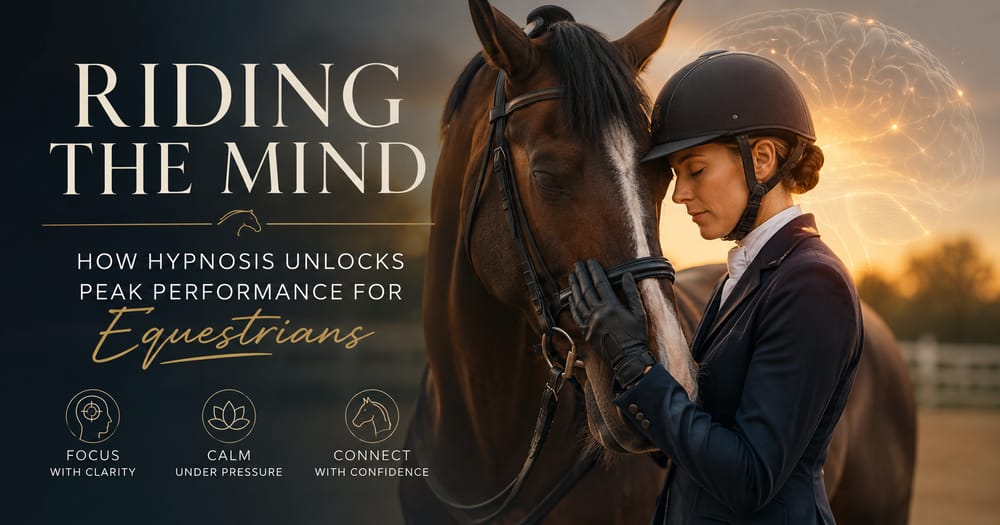
If you have ever spent time around horses, you know they are far more than powerful athletes. They are exquisitely attuned partners, capable of detecting subtle shifts in energy, posture, and focus with a sensitivity that rivals advanced biometric technology.
As someone who grew up riding and with a sister who competed internationally, I’ve witnessed firsthand how much equestrian success depends on what happens in the rider’s mind. Over the years, I have worked with riders at all levels, from recreational hobbyists to Olympians, including Hope Cooper, who rides for the U.S. Team. In every case, hypnosis has been a game-changer: helping riders sharpen focus, regulate nerves, overcome fear, and deepen the horse–rider connection.
In the equestrian world, mindset is not just “nice-to-have.” It is a critical part of the sport’s foundation. And that is exactly where hypnosis can be transformative.
The Mental Side of Riding
Equestrian sport is a dynamic partnership. You are not only mastering your own technique, you are influencing a 1,000-pound animal that responds to every conscious and unconscious signal you give.
Research in embodied cognition shows that our thoughts, emotions, and intentions are not confined to the brain (Lakoff & Johnson, 1999; Barsalou, 2008). They are expressed through muscle tension, posture, breathing, and micro-movements. Horses are remarkably adept at reading these signals. They don’t need you to say, “I’m nervous.” They sense it in the tightening of your seat, the change in your breathing rhythm, or the subtle stiffening of your shoulders.
This is why a rider’s mental state is not a “background factor,” it is a direct form of communication. A grounded, confident rider communicates trust and clarity; an anxious rider may unintentionally cue hesitation or tension. Hypnosis helps riders regulate their internal state so that what they communicate: verbally, physically, and energetically, which in turn supports optimal performance.
When the Mind Holds You Back
Performance blocks in equestrian sport often run deeper than skill gaps. They can be rooted in fear, trauma, or self-doubt - patterns the conscious mind may dismiss but the subconscious fiercely maintains in the name of protection.
One rider I worked with had experienced several serious falls. She did not compete, but riding was her passion. Every time she mounted, her muscles would tighten, her breathing would shorten, and her mind would anticipate disaster. This wasn’t just pre-ride jitters; it was a complex PTSD trauma response.
From an evolutionary perspective, her subconscious was doing exactly what it evolved to do - keep her safe, protected, and alive. The brain’s threat-detection system, including the amygdala and hypothalamic-pituitary-adrenal (HPA) axis, cannot always distinguish between a past threat and a present one. When triggered, it activates protective reflexes; heightened vigilance, rapid breathing, muscle bracing - whether or not danger is real.
Through a few targeted hypnosis sessions, we reframed her past experiences, calmed her body’s automatic threat response, and re-established trust between her and her horse. She was not only able to ride again, she was able to enjoy riding again.
Why Equestrians Seek Hypnosis
Riders from dressage, jumping, eventing, reining, and other disciplines seek hypnosis for:
• Performance anxiety before shows or clinics
• Recovering from falls or injuries and overcoming fear
• Maintaining focus under pressure
• Enhancing visualization skills for tests or courses
• Strengthening communication with the horse through mental clarity
• Breaking through plateaus in skill development
In many ways, these goals mirror those of other elite athletes. But equestrians face a unique challenge; their performance directly affects, and is affected by, another living being.
The Horse–Rider Connection
Scientific research on emotional contagion supports what experienced riders have always known: horses can sense and respond to human emotions (Keeling et al., 2009). When a rider is anxious or distracted, the horse’s performance often changes accordingly.
Hypnosis can help riders shift into coherent mental and physiological states - calm, focused, and engaged, so their cues to the horse are clean and consistent. This consistency builds trust and responsiveness, strengthening the partnership over time.
Flow in the Saddle
In sports psychology, flow is the state of complete immersion where time slows, movement feels effortless, and action and awareness merge (Csikszentmihalyi, 1990). For equestrians, flow often occurs when horse and rider are so in sync that each anticipates the other’s moves.
Hypnosis helps riders access flow more reliably by training the mind to remain relaxed yet sharply focused under pressure. Studies on visualization in sports show that mental rehearsal improves measurable performance outcomes, from increased accuracy in golfers to improved form in high jumpers (Moran, 2004). For dressage riders, this can translate into smoother transitions, more precise figures, and deeper harmony with the horse.
Lessons from Other Sports
Across sports, elite athletes use mental skills training to gain a competitive edge. Olympic skiers mentally navigate every turn before the race. Professional basketball players visualize perfect free throws. In golf, where precision and mental resilience are paramount, hypnosis and visualization are widely used to steady nerves and maintain focus.
When I worked with my sister preparing for national and international dressage tests, we applied this principle directly. While in hypnosis, I read each movement of the test, guiding her to ride it in her mind with perfect rhythm, balance, and calm. She could feel the horse’s stride, anticipate transitions, and embody the poise she wanted to carry into competition.
Functional MRI studies show that vivid mental imagery activates many of the same neural pathways as actual physical performance (Guillot et al., 2009; Kraeutner et al., 2014). The brain does not fully distinguish between reality and a vividly imagined event. By rehearsing in hypnosis, she reinforced muscle memory, enhanced the mind–body connection, and dismantled limiting beliefs that could interfere with her ride. When she entered the arena, she had already “ridden” the test successfully in her mind many times, allowing her body to follow naturally.
This approach mirrors strategies used by Tiger Woods, Michael Phelps, and Muhammad Ali, who all used mental rehearsal to prepare for peak performance. Hypnosis adds another layer by working directly with the subconscious, where emotional responses and muscle memory converge.
Case in Point: From Nerves to Nationals
I once worked with a competitive dressage rider who froze under the pressure of big shows. In hypnosis, we identified the mental and physical triggers that caused her to tighten and lose focus; things like the sound of the announcer’s voice, the sight of the judges’ booth, or the moment before the bell rang. These cues had become linked in her subconscious to tension and self-doubt.
We used targeted visualizations to mentally rehearse her ideal performance, breathwork to regulate her nervous system, and positive anchoring to rewire her response to those triggers.
Positive anchoring is a technique, rooted in classical conditioning and popularized in neuro-linguistic programming (NLP), that pairs a desired mental state with a specific stimulus, such as a touch, gesture, or cue word, so that the stimulus can later be used to instantly recreate that state. In her case, we anchored the feelings of calm, confidence, control, and fluid connection with her horse to a subtle cue she could use in the saddle. By practicing this in hypnosis, her subconscious learned to automatically associate the anchor with her peak performance state.
By competition day, when those familiar triggers appeared, her body no longer braced for failure, instead, the anchor brought her instantly back into focus, relaxation, and trust in her horse. The result? She delivered her best test of the season and described the ride as, “It felt like my horse, and I were dancing.”
Why This Niche Matters
Equestrian hypnosis remains an untapped niche in sports psychology. As more riders realize that mental conditioning is just as vital as physical training, for both horse and rider, hypnosis will become an essential tool for those who want to compete, recover from setbacks, or simply ride with more joy and confidence.
Final Thought
In riding, as in life, the mind leads and the body follows, and in equestrian sport, the horse follows too. Hypnosis aligns mind, body, and energy so that the horse–rider partnership can reach its highest potential. Whether you’re aiming for Olympic gold or seeking a relaxed trail ride, mastering your inner state is the most powerful aid you can carry into the saddle.
References
Barsalou, L. W. (2008). Grounded cognition. Annual Review of Psychology, 59, 617–645.
Csikszentmihalyi, M. (1990). Flow: The psychology of optimal experience. Harper & Row.
Guillot, A., Collet, C., Nguyen, V. A., Malouin, F., Richards, C., & Doyon, J. (2009). Brain activity during visual versus kinesthetic imagery: An fMRI study. Human Brain Mapping, 30(7), 2157–2172.
Keeling, L. J., Jonare, L., & Lanneborn, L. (2009). Investigating horse–human interactions: The effect of a nervous human. Veterinary Journal, 181(1), 70–71.
Kraeutner, S. N., McWhinney, S. R., Solomon, J. P., Dithurbide, L., & Boe, S. G. (2014). Experience modulates motor imagery-based brain activity. NeuroImage, 99, 237–248.
Lakoff, G., & Johnson, M. (1999). Philosophy in the flesh: The embodied mind and its challenge to Western thought.Basic Books.
Moran, A. (2004). Sport and exercise psychology: A critical introduction. Routledge.

Hemisphere Hypnotherapy
I'm Carla Chalah
Your journey to holistic well-being and personal growth begins here.
My practice is dedicated to helping you achieve a healthier, more fulfilling life through the transformative power of hypnotherapy.
Click here to go to the Blog Home.

Welcome to Hemisphere Hypnotherapy, where mindset meets magic and neuroscience makes it stick.
Change your mind. Change everything.
Rewire your patterns, reset your nervous system, and start living a life worth celebrating through the power of hypnosis.
Welcome to Hemisphere Hypnotherapy, where your journey to holistic well-being begins. My practice is dedicated to helping you achieve a healthier, more fulfilling life through the power of hypnotherapy.
NAVIGATION:
CONTACT:
- 321A Boston Post Road
Suite 2B
Sudbury, MA 01776